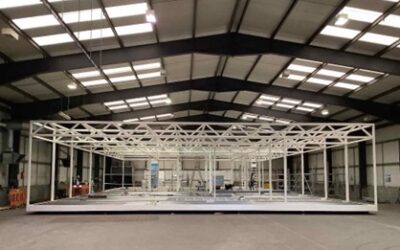
Ardmac continues to lead in construction innovation by introducing robotic layout solutions across on-site operations. This cutting-edge technology is transforming how layouts are completed, delivering greater precision, speed, and efficiency throughout the process.
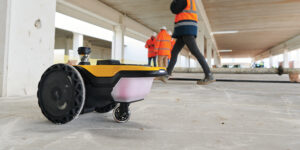
Ardmac use a compact, autonomous robot that prints digital CAD layouts directly onto construction surfaces. Manual marking has always been a time-consuming and labour-intensive task, with accuracy depending heavily on individual skill, often affected by human error. This is now changed by automating the process, achieving millimetre-level precision while reducing labour requirements and rework.
For the construction industry, layout inaccuracies and manual marking have long contributed to delays and additional costs. Ardmac recognised these challenges – slow processes, inconsistent markings, and heavy reliance on skilled labour, and sought a more reliable and efficient approach.
Trial Overview & Goal
In October 2025, Ardmac trialled the robotic marking solution on a project in Limerick, Ireland. The goal was to understand how autonomous technology could support cleanroom installation – especially ceiling suspension, panel, and door layouts – while improving accuracy, speeding up workflows, and reducing overall project costs.
Project Aim
The trial aimed to demonstrate how a structured, technology-led approach could:
- Save time by reducing the need for slow, manual marking methods
- Lower costs through improved productivity and reduced rework
- Increase accuracy in cleanroom setout, supporting smoother installation and better project delivery
- Enhance certainty for project teams by providing consistent, repeatable markings directly from coordinated digital models
Technology in Action
The robot uses Total Station control points and digital model inputs to print layout markings directly onto the floor slab. The process replaces traditional manual marking, creating a more streamlined, consistent, and data-driven approach to site layout.
Key Benefits
- Cost Efficiency: Estimated cost per m² reduced by circa 30% for setting out.
- Labour Optimisation: Crew requirement reduced from three people to one.
- Improved Accuracy: Better precision in cleanroom set out, supporting smoother installation and constructability reviews.
Strategic Impact 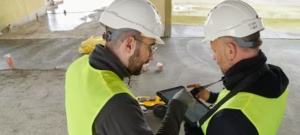
The trial highlights Ardmac’s proactive approach to adopting technology that strengthens precision, safety, collaboration, and innovation. By introducing robotics into layout workflows, we continue to deliver smarter and more efficient solutions for our clients – while maintaining our high standards in quality and safety.
Driving Innovation: Ardmac’s Vision
Fabrizio Giargeri (Ardmac’s BIM Manager), Peter Gough (Associate Director) and Alan Kennan (Project Manager) played a key role in bringing this technology to the company. Their passion for digital transformation and strategic thinking helped integrate this solution into our BIM and site execution plans.
Peter and Alan sought opportunity to enhance Ardmac’s project delivery by utilising BIM and Innovation to support a more efficient setting out process whilst continuing to support our Safety-First culture.
The new technology supports this by reducing the physical strain and risks linked to manual layout tasks.
“Bringing digital design to the job site is a game-changer. It eliminates inefficiencies, reduces risk, and empowers teams to deliver with confidence. This is a new way of working that sets the standard for the future of construction.” Fabrizio explains.
The robot now works seamlessly with coordinated digital models, enabling faster, more accurate layouts and supporting Ardmac’s focus on lean, technology-driven construction.
In a sector dealing with labour shortages and increasing project complexity, the robot sets a new standard for how smart construction can enhance quality and consistency.
Enhanced Safety
The robot cuts down on repetitive movements, reduces the need to work in awkward positions, and keeps personnel away from busy or uneven areas during early construction stages.
With fewer manual touchpoints and more predictable layouts, teams can work more safely while maintaining excellent levels of accuracy and efficiency.